
Career Growth. Now that is a key aspect in the minds of all Corporate Executives. Especially at the early stages we dream of reaching at the very top of whatever takes us wherever. Little do many of us understand that just like any other defining aspect of our life – decisions that can significantly alter the course of our life (such as Education, First Job, Marriage, Childbirth, Saving / Investment for Pension etc) Managing one’s career too is a key decision and one that comes with a lot of deep thought, and needs guidance for many.

The word Career and the Word Growth if juxtaposed indicate an accelerating rise in the Corporate Hierarchy of an individual. In other words rising levels towards the pyramidical top
Lets us therefore take a look at what is the organisation structure (whether a Corporate or ones own business / entrepreneur model). At this point we need to also consider the Fundamental Aspects of Career Growth.
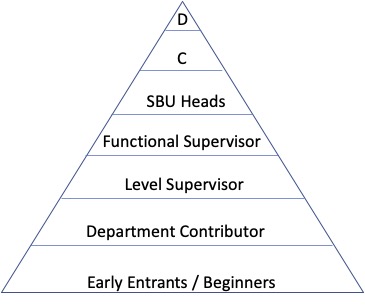
A typical Corporate Structure shows the level wise rise / growth that an individual can expect if s/he were to consistently grow within the organisation. Starting from that of an early entrant (one with some experience or higher than average academic qualification) / beginner (just out of campus after basic education). Within a few years, the person becomes a Department Contributor (a look at the 9th Box-ers in other posts / pages, indicates the super stars with higher growth propensity). The first level growth is considered as the Supervisory stage with managing team members, starting with level Supervisor growing to be a Functional Supervisor. An example of this is say Head of Audit, and the next level being Compliance Head. Thereafter we have SBU heads – managing a strategic team and responsible for either profitability / expense management. In the same example say a Finance Controller. We then move up to the C – Executive Suite where the Decision making executives sit on the table. At this stage the individual may be a Chief Financial Officer and finally the next level being that of D Suite – Directors. It is here that we have the Managing Director, Executive Directors, Board etc and senior-most within them being the Chairman.
Lets take a look at the differentiated Hierarchies for Large, Medium and Small / Micro organisations
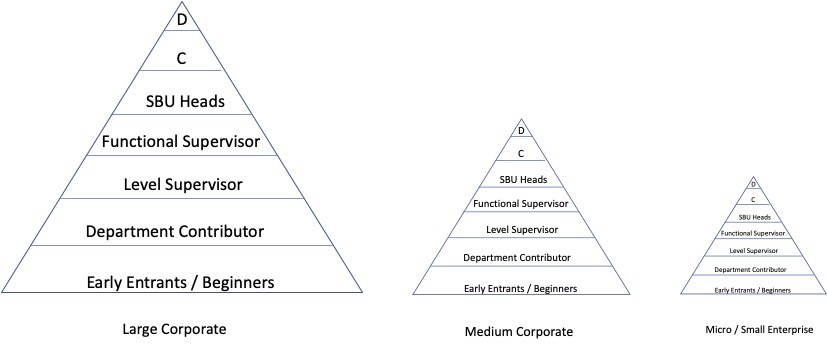
In the image above – A Large Sized Corporate Functional Supervisor could well become a Director at a Medium Sized Corporate and a Level Supervisor of a Medium Sized Corporate could well be a SBU head of a Small Sized Corporate. These aspects are an example and are not a direct representation and may be varied for organisation and industry types.
In other words, Growth in Career is dependent on the scale of operations and the decision making capability of the individual based on experience and exposure. To sum up this article, a good indicator of Career growth may well be the decision making capability involving size of revenue / profits or funds managed (in case of non for profit organisations). To know more contactus@9thbox.in
9th Box is a part of Natarajans Consulting, an organisation focussed on a 360 development of people and organisations to do more. We primarily focus on MSME growth which feeds into Larger organisations.